One steering law: coco, rockwool, soil and water
Coco, rockwool, soil and a tank of water use the same method of steering. This paper gives the method one time, with diagrams. Then you can use the method with each substrate, because the substrate changes only the numbers.
Purpose and scope
A cannabis plant can use its energy to make leaves. A plant with more leaves is larger and has more green material. The plant can also use its energy to make flower. Flower is the group of buds with resin that you harvest. ‘Steering’ is the control of the plant with water. The water causes a small change in the plant in the direction of more leaves or more flower.
The three controls do not change. You use the same three controls for each substrate:
- Water content is the quantity of water in the substrate at this time. The grower term is volumetric water content (VWC). Use this one number to control the plant.
- Dryback is the quantity by which the water content decreases each day. You control the quantity of water that the plant removes from the substrate. This control has the largest effect.
- Feed strength is the concentration of the feed around the roots. The grower term is EC. You select the strength of the feed.
The substrate (coco, rockwool, soil or a tank of water) does not change the three controls. It changes only the numbers.
After you read this paper, you will know the full procedure. Each morning, at lights-on, let the water content decrease by a small quantity. Then fill the substrate again with small shots. A shot is a small quantity of water that the dripper supplies in a short time.
Keep the water content stable during the day. During the night, let the substrate dry. The next day, start again. The other sections of this paper give more information about each part of this loop.
Definitions
If a term in this paper is new to you, find it in this section. Each item gives the term and then the definition.
Evidence and limitations
We want each paper to be correct. Thus we examine each paper for information that is not solid. This information comes from the view of one grower, from a small number of sources, or from grower methods that have no controlled test. We identify this information, and we do not show it as solid.
Frequently there is no paper for the decision that you must make. Then we use the reports of other growers and the methods that work in the rooms that we know. This information can help you, but it is not the result of a laboratory test. Use the methods that work for your plants, for your room and for your meters. If a table does not agree with your crop, use the data from your crop and record the difference.
- The wet and dry cycle and the strength of the feed are the same steering controls in all media.
- Soil is a buffer. Coco, rockwool and water do not have the same buffer.
- One model for all substrates, with a drive and a brake.
- Coco procedures for a new grower that use the high-intensity substrate EC values of rockwool.
- Root rot in DWC in one day or less at more than 23 °C as a time for all systems. DO and heat change the time.
If you find an error, make a report. We will correct it. Make the report on GitHub, with the name of the paper and the information that is incorrect. If you have a source, include it: Make a report of an accuracy problem. The regulations, labels and licenses of your area always override each procedure in these papers. The label weak in a paper shows the points where the risk of an error is highest.
Substrate water storage
The substrate is the material that contains the roots. The total space in the substrate is constant, and each pore contains water or air. When water goes in, the water pushes air out. When there is more water, there is always less air.
The quantity of air is important because the roots must have air and water. If the substrate stays too wet, the roots do not get sufficient air. If it stays too dry, the growth of the roots stops. Each substrate has a different usual ratio of water to air.
Different substrates keep very different quantities of air, also when the substrate is fully wet[7]. This one fact causes the difference between substrates in the risk that you apply too much water.
A substrate has a second trait that you do not see easily. This trait is also important: the buffer. The buffer is the quantity by which the substrate decreases the effect of an error in the feed. Some substrates absorb the error and prevent damage to the plant[6].
In other substrates, the effect of the error occurs immediately. This paper gives the measurements in a subsequent section. At this time, we use only the terms ‘large buffer’ and ‘small buffer’.
Water content and dryback
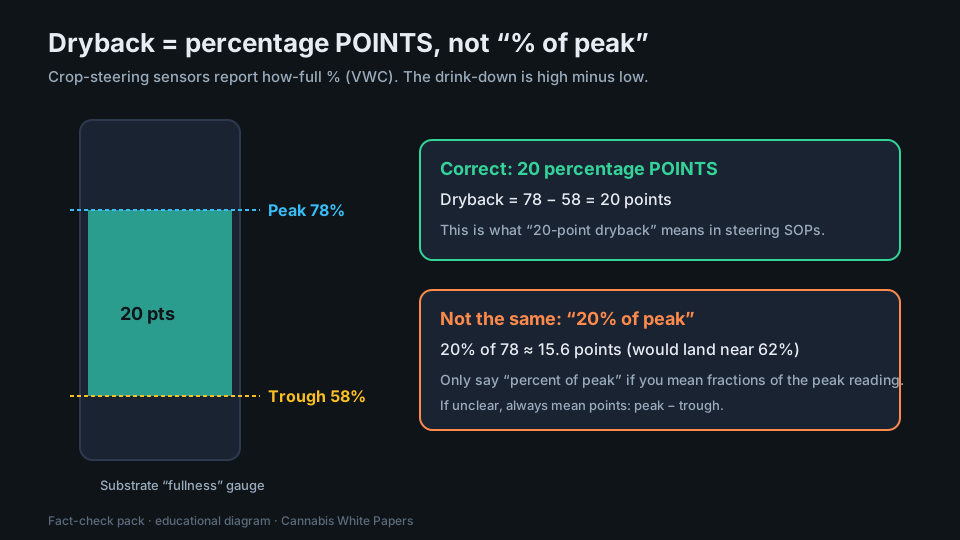
Water content is the one number that you use to control the plant. It shows the quantity of water in the substrate at this time. At 60%, water fills 60 of each 100 pores. Dryback is the quantity by which the water content decreases between two shots. It is the high value after a shot, minus the low value before the next shot.
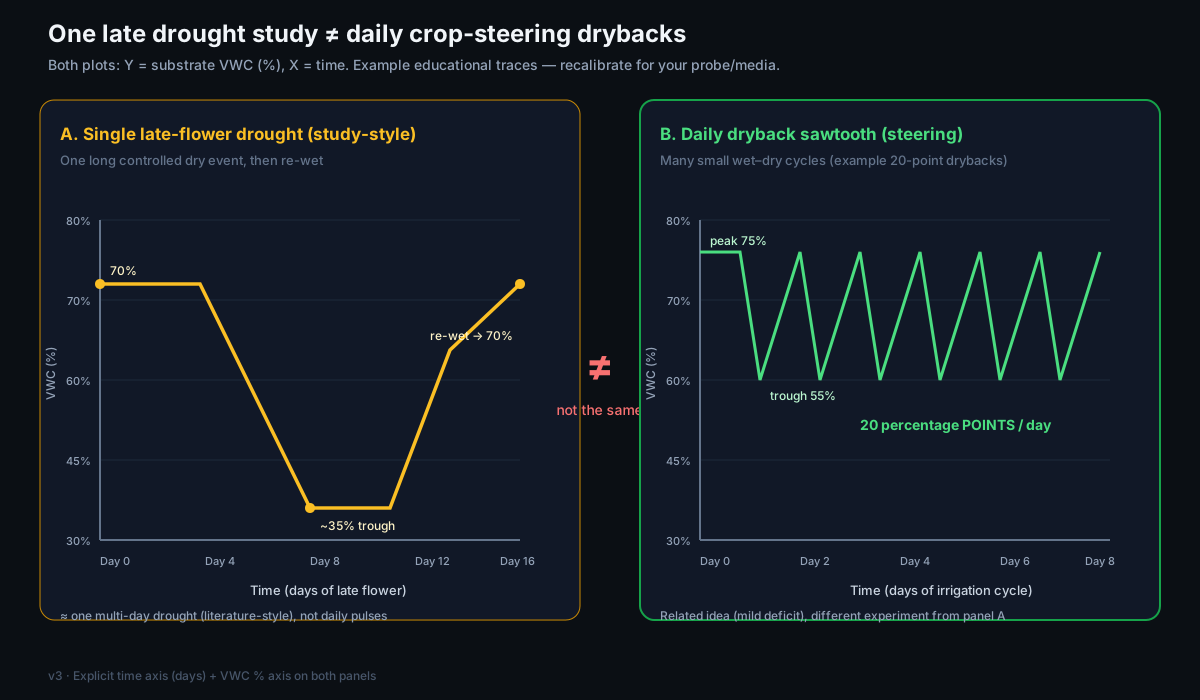
How drying controls the plant. A small water deficit each day causes a change in the plant. The same change occurs at the end of summer. As a result, the plant makes flowers quickly, and not more leaves[1].
This effect occurs through a stress hormone that the plant releases when it has a small water deficit[2]. The effect is a small change, and not damage. It is not necessary to know the name of the hormone for the steering.
Larger drybacks cause more flower (the buds). Smaller drybacks, with a wetter substrate, cause more leaves and a larger plant. The control is the same, and only the size of the dryback is different. The effect increases during some days. It does not occur in one night. Make a small change each day.
Feed strength and root-zone EC
Feed strength (the grower term is EC) is the concentration of the fertilizer feed around the roots. A higher EC is a stronger feed with more salt. The feed strength changes when the water content changes. One fact causes this change. When the substrate dries, the quantity of water decreases and the nutrients stay. Thus the feed becomes stronger, although you do not add more feed[4].
As a result, a large dryback for flower is a change in the feed strength and also a change in the water. Water and feed are the same control.
Read the two numbers together. When the water content decreases, the plant uses water. This effect is good until the water content decreases too much. It is usual that the feed becomes stronger when the substrate dries.
If the feed strength increases by a large quantity in a short time, the feed has too much salt. Then apply more water to decrease the concentration of salt.
If the feed strength decreases slowly during some days, the plant uses nutrients faster than the feed supplies them. Then increase the feed strength by a small quantity. A weaker feed and a wetter substrate cause more leaves. A stronger feed and a drier substrate cause more flower.
Field capacity and dryback limits
Field capacity is the highest water content that the substrate has after the drainage of water stops. It is the maximum value of each day, and you fill the substrate until the water content is at this value. The value is different for each pot and each substrate. It is not a reference value, and it decreases when the roots fill the pot. You find it from a small number of irrigation events.
The recovery floor is a safety limit. If the substrate dries to less than this value, it does not absorb water again, and the water flows straight through it. The dripper cannot correct this condition. You must soak the substrate manually, or use a new substrate. The dryback is your steering, and the recovery floor is your safety limit. They are two different numbers.
Runoff is the small quantity of feed that drains from the bottom of the pot each day. It is approximately 10 to 20% of the feed that you apply. Runoff is not waste. It removes the salt that collects in the substrate. When you measure the runoff, you find the correct feed strength of the substrate.
Irrigation phases in each day
Do not apply water at random times. Apply water in four phases at the same times each day. The phases agree with the lights. The four phases have the labels P0, P1, P2 and P3. In this paper, the phases are:
- Small dryback
At lights-on, let the water content decrease by a small quantity before the first shot. The dryback of this phase is the first dryback of the day, and you control it.
- Fill
Fill the substrate again with small shots. Increase the size of each shot by a small quantity. Continue until the water content is at the peak of the day. Stop at this value. Frequently, you do not apply all the shots that you selected for the phase.
- Stable water content
Keep the water content in a range all day. When the water content is less than the lowest value of the range, apply a small shot. Make small changes to the feed strength to control the plant.
- Night dryback
Stop the shots before lights-off. During the night, apply water only in an emergency. The large night dryback sets the substrate to the start condition for the next day.
A shot is a small quantity of water that the dripper supplies in a short time. The size of a shot is a small percentage of the volume of the substrate. The irrigation controller calculates the time of each shot, in seconds. It uses the size of the pot, the flow rate of the dripper and the number of drippers. You give the controller these three values.
A correct graph of the water content has the shape of a sawtooth. The line decreases slowly (the dryback) and then increases quickly (a shot), and the two parts occur again and again. A line that does not change, or a line that only decreases, shows that the irrigation does not occur. There is a fault.
In one room, the steering law is this: vegetative mode and generative mode use the same four phases. Only the target numbers change. The target numbers are the size of the dryback, the feed strength and the size of the shot. The rhythm does not change.
Substrate moisture as the control variable
This section has the most important information in this paper. The substrate has a transfer function: it changes your irrigation by constant quantities before the roots receive it. The same irrigation has a different effect for each substrate. Thus a new substrate does not cause a new method of steering. You find only four numbers for the new substrate. The four numbers are the water content at field capacity, the quantity of air at field capacity, the buffer, and the recovery floor.
Each substrate has the same set of items, and only the numbers are different. The table shows this:
| Specification | Coco | Rockwool | Living soil | Water (tank) |
|---|---|---|---|---|
| Air when fully wet | Approximately 22%. Coco keeps the most air, and you cannot easily apply too much water. | Approximately 10%. Rockwool holds the most water, and it is easy to apply too much water. | More air than rockwool. For peat, the value is approximately 18 to 25%. | The roots are in the water. An air pump supplies the air. |
| Buffer (decreases the effect of an incorrect feed) | A large buffer that is part of the coco. | Almost no buffer. The plant gets the feed that you set. | The soil corrects errors in the feed. Organisms and minerals make the feed stable in minutes. | No buffer. The tank is the only buffer. |
| Recovery floor and primary fault | When the coco dries, the effect on the plant is slow. The reading of the feed strength can be incorrect when the coco is almost dry. If you do not first soak the coco in calcium and magnesium, it removes calcium and magnesium from the feed. | The limit is at approximately 25 to 30%, and the change at the limit is fast. At less than this value, channeling occurs. The plant shows the effect in the same hour. | A large buffer. There is no fast change at a limit. Too much water has no effect that you can see at first, and then the problem increases. | There is no fast change for dry conditions, but there is a limit for heat. Root rot occurs at a temperature of more than approximately 23 °C (73 °F), in one day or less. |
| Procedure to prepare the substrate, and pH at the start | Soak the coco in a solution of calcium and magnesium for 8 to 24 h. The pH of the feed is 5.8 to 6.2. | The pH at the start is approximately 8. Before you use the rockwool, change the pH to approximately 5.5. Then keep the pH at 5.5 to 6.0. You can use the rockwool again for approximately 3 years. | The soil sets the pH at approximately 5.2 to 6.5. Usually, you do not adjust the pH of the input water. | Keep the pH at 5.5 to 6.0. Keep the tank at 18 to 20 °C (64 to 68 °F). Operate the air pump all the time. |
| Good for a new grower | Yes. Soak the coco in calcium and magnesium before you put the plants in it. | It gives accurate control, but it has almost no buffer. Use an easier substrate first. | Yes. It has the largest buffer of the four substrates. | No. Use it only after you use the easier substrates. |
The table shows this: when a substrate gives more control, it has a smaller buffer for your errors. Thus a new grower starts with a substrate that has a large buffer, and then uses the substrates that have a smaller buffer.
| Vegetative mode | Generative mode | |
|---|---|---|
| Lights | 12 / 12 | 12 / 12 |
| Field capacity | Find the value for each pot. | Find the value for each pot. |
| Dryback | 5 to 15 points | 20 to 30 points |
| Feed strength | Approximately 3.0 | 4.5 to 6.0 |
| Shots | Many small shots | A small number of large shots |
Sensor accuracy and readings
A probe finds water because water has a much stronger effect on the weak electric field of the probe than dry substrate or air has[8]. The probe uses this large difference in coco, rockwool and soil.
A high resolution is not the same as accuracy. The probe shows many decimal places, but it can have an error of a small number of points[9]. Until you calibrate the probe for your substrate, it is possible that you control the plant in the range of the error.
One probe is one local measurement. It measures only the small volume of influence around the probe, and not all the pot. Do not connect one probe directly to a valve. Do a second check (the water that drains from the pot, or the weight of the pot) before you apply water. Use the shape of the dryback to control the plant, and not the value of one reading.
Decisions of the automatic irrigation controller
A good controller calculates the water balance all the time. The controller adds the water from the shots of the dripper, and you know this quantity accurately. The controller subtracts the water that the plant transpires and the water that drains. The result is the quantity of water in the pot. The sensor gives one estimate, and the controller compares it with the water balance. The sensor is not the only source of data.
Each estimate has a confidence. The confidence is high when the data agree and low when the data do not agree. When the confidence is high, the controller applies a full shot. When the confidence is between high and low, it applies only a small, safe shot. When the confidence is low, the controller waits or gives the decision to a person.
The decision has only three possible results, and one safety instruction applies to all three. A sensor with an incorrect reading can only make the controller more careful. It cannot cause the controller to apply too much water.
The controller uses the same method for each substrate. The method has three steps, and it is the same for coco, rockwool, soil and water. The controller examines the data, calculates the water balance, and uses the confidence to select the correct step. The substrate changes only the numbers that the controller uses. It does not change the method.
The steering law for all substrates
All the information in this paper is for one system. The system has four parts: the substrate, the water content, the dryback and the feed strength. The four parts operate in the four phases of each day. The probe and the automatic controller are optional. Add them only if you use automatic irrigation.
The same sawtooth of each day is correct for each substrate. Only the numbers are different:
During a full crop cycle, the dryback has the same shape on each substrate. In the first stage, the dryback is small and the substrate is wet. Through the middle of flowering, the dryback is larger and the substrate is drier. Near the end, the dryback becomes smaller. Vegetative mode uses small drybacks, and generative mode uses larger drybacks. The method of steering is the same.
There is no one set of numbers that is correct for all rooms. Start with a substrate that has a large buffer (living soil or coco). Put a probe in the root zone. Monitor the data of the probe for one usual day. Then change one control at a time. This method, and not a number, gives the same results each time in each substrate.
For more information, read the papers about crop steering in coco and crop steering in rockwool. The paper about the root-zone sensor shows how the sensor measures the substrate. The paper about automatic irrigation gives information about the controller.
References
- Caplan D, Dixon M, Zheng Y (2019). Increasing inflorescence dry weight and cannabinoid content in medical cannabis using controlled drought stress. HortScience 54(5):964-969. https://doi.org/10.21273/HORTSCI13510-18
- Welling MT, et al. (2025). Regulation of secondary metabolism in Cannabis sativa L. by abscisic acid and water deficit during early flower development. Plant Stress 17:100968. https://doi.org/10.1016/j.stress.2025.100968
- Stack GM, Cala AR, Quade MA, et al. (2024). Severe drought significantly reduces floral hemp (Cannabis sativa L.) yield and cannabinoid content but moderate drought does not. Ind. Crops Prod. 209:117974. https://doi.org/10.1016/j.indcrop.2024.117974
- Hilhorst MA (2000). A pore water conductivity sensor. Soil Sci. Soc. Am. J. 64(6):1922-1925. https://doi.org/10.2136/sssaj2000.6461922x
- Abad M, Noguera P, Puchades R, Maquieira A, Noguera V (2005). Physical properties of various coconut coir dusts compared to peat. HortScience 40(7):2138-2144. https://doi.org/10.21273/HORTSCI.40.7.2138
- Noguera P, Abad M, Puchades R, Maquieira A, Noguera V (2003). Influence of particle size on physical and chemical properties of coconut coir dust as container medium. Commun. Soil Sci. Plant Anal. 34(3-4):593-605. https://doi.org/10.1081/CSS-120017842
- Malik M, Tlustoš P (2025). Soilless growing media for cannabis cultivation. Agriculture 15(18):1955. https://www.mdpi.com/2077-0472/15/18/1955
- Szerement J, Woszczyk A, Szyplowska A, Kafarski M, Lewandowski A, Wilczek A, Skierucha W. A Seven-Rod Dielectric Sensor for Determination of Soil Moisture in Well-Defined Sample Volumes. Sensors (Basel). 2019;19(7):1646. https://doi.org/10.3390/s19071646
- Advancements in dielectric soil moisture sensor calibration: A comprehensive review of methods and techniques. Computers and Electronics in Agriculture. 2024;218:108663. https://doi.org/10.1016/j.compag.2024.108663
The Cannabis White Papers · CC BY-NC 4.0 · version 1.2 · updated 2026-07-18