PPPE: plant and personal protective equipment
Coveralls, hairnets, gloves and shoe covers give the worker protection from hazards, and they keep contamination from the worker away from the crop. The contamination is the particles, the microbes and the pests of the worker. A person is the primary source of contamination in each clean production space. This paper gives information about the quantity of contamination that a person releases. It also gives the minimum PPE for each production area and the equipment for each room. It gives the procedures for gowning and hand hygiene that stop contamination at the demarcation line between clean and dirty areas.
Purpose and scope
In a grow room, PPE is not only for you. In most rooms, the equipment gives protection to the plant from you. The contamination is the skin flakes that you release. It is also the spores on your jacket, the mites on your shoes and the viroid on your hands. The same coverall that keeps your clothing clean also keeps your contamination away from the crop. Thus the name is PPPE: plant and personal protective equipment.
Persons are typically the primary source of contamination in each clean space. The percentage is different in different facilities.[1] A person cannot stop the particles that the person releases. You can only put a barrier around the person and control the movement of the person through the building.
Definitions
Evidence and limitations
We want each paper to be correct. Thus we examine each paper for information that is not solid. This information comes from the view of one grower, from a small number of sources, or from grower methods that have no controlled test. We identify this information, and we do not show it as solid.
Frequently there is no paper for the decision that you must make. Then we use the reports of other growers and the methods that work in the rooms that we know. This information can help you, but it is not the result of a laboratory test. Use the methods that work for your plants, for your room and for your meters. If a table does not agree with your crop, use the data from your crop and record the difference.
- Persons are a primary vector of contamination. HpLVd can move on tools and on hands.
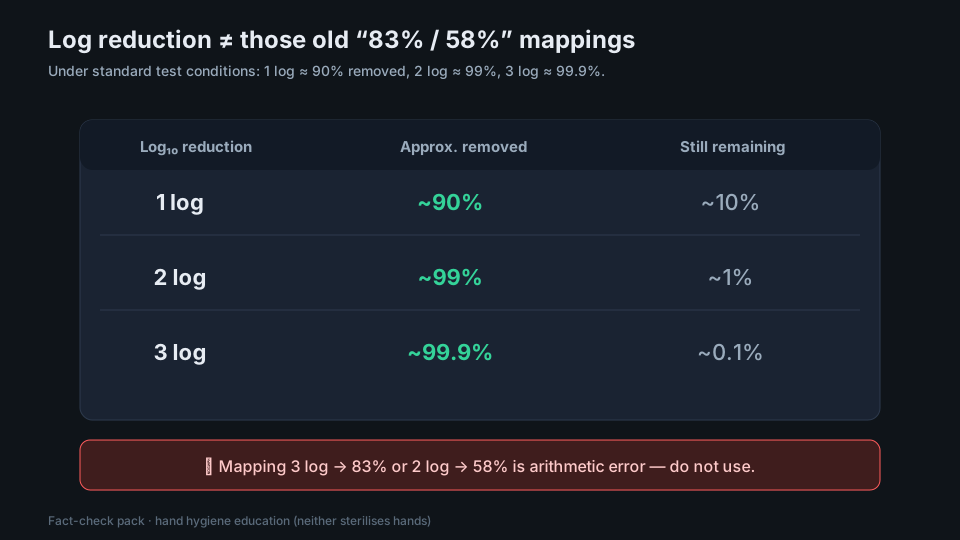
- The log reductions for hand hygiene use a log scale. In test conditions, they are approximately 90%, 99% and 99.9%.
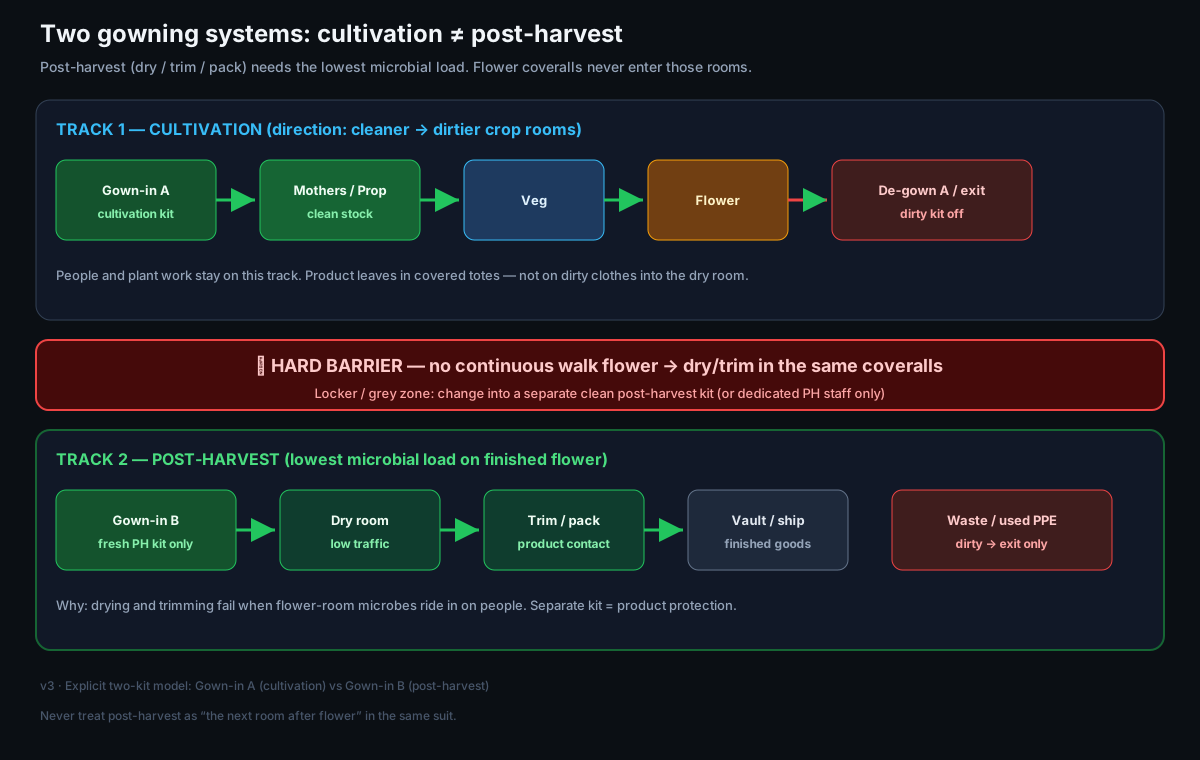
- The flow of personnel is from clean to dirty areas. The flow of waste is from dirty areas to the exit.
- The sequence of gowning, and models with two kits, for cultivation and for post-harvest.
- The NZ HSWA structure for PPE, where it is applicable.
- One value of 70 to 90% for the part of cleanroom contamination that persons cause, as a constant for all conditions.
- The contamination of a phone compared with a toilet seat, as an accurate measure of biosecurity.
If you find an error, make a report. We will correct it. Make the report on GitHub, with the name of the paper and the information that is incorrect. If you have a source, include it: Make a report of an accuracy problem. The regulations, labels and licenses of your area always override each procedure in these papers. The label weak in a paper shows the points where the risk of an error is highest.
Risks of contamination from personnel
A person in a cultivation room is the primary source of contamination in the space. The person releases particles, microbes and pests all the time, only because the person is in the room.
- Movement increases the quantity of particles. A person in a gown releases approximately 100,000 particles each minute when the person does not move. The person releases approximately a million when the person walks, and a maximum of five million when the person works fast.[1] Slow movement is a control.
- Your phone is a fomite that you touch frequently. A phone has skin microbes and microbes from the environment on it. The phone goes to your head and back to your hands all day.[4]
- Your shoes move pests and spores. The soles have viable pathogens and fungal spores on them. When you walk, the organisms on the floor go into the air again.[5] Mites and powdery mildew come into the room on clothing and footwear.
- A toilet makes a plume of aerosol. When a person flushes the toilet, aerosol goes to a height of approximately 1.5 m (4.9 ft) in seconds. The aerosol stays viable for minutes to hours. A closed lid decreases the aerosol by a large quantity.[8]
Minimum necessary PPE
- Clean outer clothing for this area only, which you put on at the entrance (gown, smock, scrubs or coverall). Do not use your street clothes.
- Hair and beard cover. Put a bouffant or a hairnet on all of your hair. Put a beard cover on facial hair.
- Single-use nitrile gloves. Use gloves that have no damage. Replace a glove when it has damage or contamination.
- Footwear for this area only: room shoes or shoe covers. Do not use the boots that you wore in the parking area.
- Hand hygiene. Do hand hygiene at the entrance, after contamination and after you are away from the area.
- No personal items. Keep your phone, jewelry, watch and makeup in a locker before you go into the area.
PPE for each room
The grade of PPE is different for each room, because the value of the contents and the risk to the contents are different. Do not use the same PPE in all rooms. Use the highest grade where the genetics are, and where the product is open and goes to a patient.
| Zone | PPE grade | Primary items |
|---|---|---|
| Tissue-culture lab | Aseptic / ISO-5 | Scrub the arms to the elbows. Use sterile gloves and a lab coat. Work in a laminar-flow hood. Do not use jewelry. |
| Mother / propagation | Highest biosecurity | Full gown. New gloves for each plant. Tools for this room only. Work in this room first in the day. |
| Dry / cure | Cleanroom grade | The product is open, and the microbial specification is a release gate. |
| Vegetative stage / flowering stage | Standard gown | Gown, hairnet, gloves, footwear for this room only, sticky mat at the door |
| Trim / packaging | Food-contact grade | Hairnet, beard net, gloves, smock. Change the gloves frequently. |
| Vault / storage | Minimum (security) | Gloves to keep the product clean. The controls are mostly for security. |
Gowning procedure
The sequence is important. Put on the PPE from the top to the bottom. Thus the particles that you release when you put on the clothing fall on parts of the body that have no clothing at this time. At the same time, you go across the demarcation line between the dirty area and the clean area.[13]
Hands and gloves
Hands move most of the contamination from one area to a different area. Thus hand hygiene is the task that you do most frequently in the building. Do hand hygiene at the entrance, and before clean work or aseptic work. Do it also after waste or contamination, after you are away from the area, and when you go in again.[11]
Frequent errors of compliance
Phones and personal items
Do not put phones, earbuds, jewelry, watches or makeup into production areas or clean areas. A phone is a fomite that you hold to your head, and you cannot clean it.[4] Put all of these items in lockers before you go into the gowning room.
The toilet
A toilet must not have a door into a production area. When a person flushes a toilet, viable bioaerosol goes to a height of more than 1 m (3 ft) in seconds.[8] Thus a person who comes back from the toilet can move contamination into the area. The risk continues until the person washes the hands and does the gowning procedure again.
Food, drink and break areas
Do not eat, drink, use chewing gum or use an electronic cigarette in a production area. Before you go to a break area, do the de-gowning procedure. When you come back, wash your hands and do the gowning procedure again.
Footwear and the floor
Cross-contamination: flow in one direction
Duties in HSWA 2015
- Make sure of the health and safety of workers, as far as is reasonably practicable (s36).
- Apply the higher controls before you use PPE.
- Supply PPE and replacements. Make sure that the workers have no cost for PPE (s27).
- Give information, training, supervision and sufficient facilities.
- Use reasonable care for their safety and for the safety of other persons (s45).
- Obey the reasonable instructions. Put on the necessary PPE. Obey the SOPs for gowning and hygiene.
- Do not use safety items incorrectly. Do not change them or cause damage to them.
- Visitors have the same duties: use reasonable care and obey the instructions.
Reference list
- Baseline for each room
- Gown, hairnet and beard net, gloves, room shoes, wash the hands, no personal items
- Gowning sequence
- Hair, then mask, then eyewear, then inner gloves, then coverall, then hood, then boot covers, then outer gloves
- De-gowning
- Opposite sequence, dirtiest item first, then wash the hands
- Hand wash
- Soap: 40 to 60 seconds. Alcohol rub: 20 to 30 seconds (minimum 60% alcohol).
- Gloves
- Remove first, inside-out. Wash your hands also when you use gloves. In propagation, new gloves for each plant.
- Phones
- Do not put phones into clean areas. Use lockers before the gowning room.
- Toilet
- Do the de-gowning procedure. Close the lid. Wash the hands. When you come back, wash and sanitize the hands. Do the gowning procedure again.
- Flow
- Persons and materials: from clean to dirty. Waste: from dirty to the exit. To go back, do the gowning procedure again.
- Regulations (NZ)
- The PCBU supplies PPE at no cost to workers (s27). PPE is the last control.
References
- Cleanroom contamination analyses: personnel are typically the dominant contamination source (industry figures often cite a large majority; exact share varies by facility); a gowned worker emits ~100,000 particles/min at rest, ~1,000,000 walking, up to ~5,000,000 in active work. (source not from a journal, for example from a manufacturer). https://www.precgroup.com/70-percent-of-cleanroom-contamination/
- Noble / CDC Emerging Infectious Diseases: humans disseminate ~10^7 skin squames per day, of which roughly 10% carry viable bacteria. https://wwwnc.cdc.gov/eid/article/7/2/70-0225_article
- Human microbial-emissions research: an occupied space gains roughly 37 million bacterial and 7 million fungal genome copies per person per hour above the unoccupied baseline. https://pmc.ncbi.nlm.nih.gov/articles/PMC7950481/
- Mobile phones as fomites: high-touch devices carry skin and environmental flora (methods and comparisons vary across studies), isolates including S. aureus, E. coli and Candida. https://pmc.ncbi.nlm.nih.gov/articles/PMC3939586/
- Shoe-sole and floor contamination: soles carry MRSA, C. difficile, E. coli and other organisms; walking re-disperses settled organisms, contributing a meaningful share of airborne CFU. (source not from a journal, for example from a manufacturer). https://www.infectioncontroltoday.com/view/shoe-sole-and-floor-contamination-new-consideration-environmental-hygiene
- Mechanical transmission and management of Hop Latent Viroid (HLVd) in cannabis: spread via contaminated tools and cuttings; under experimental conditions linked cuttings can approach complete infection within weeks; controls include fresh gloves per plant, tool sterilisation and footbaths. Plants (MDPI) 2025, 14:830. https://www.mdpi.com/2223-7747/14/5/830
- Comparative hand-hygiene efficacy: alcohol-based handrubs often achieve ~2–3 log reductions of transient flora under test conditions (~99–99.9%); soap and water remove soil and many organisms but neither sterilises hands. (Note: 1 log ≈ 90%, not ~58–83%.). https://www.ncbi.nlm.nih.gov/pmc/articles/PMC117885/
- Toilet-flush bioaerosol ('toilet plume'): a flush lofts aerosols to ~1.5 m within seconds; particles remain viable for minutes to hours, and a closed lid produces markedly less aerosol. https://pmc.ncbi.nlm.nih.gov/articles/PMC9732293/
- US FDA. 21 CFR 117.10, Personnel (current good manufacturing practice for food): clean outer garments, personal cleanliness, hand washing, hair restraints, glove integrity. (source not from a journal, for example from a manufacturer). https://www.ecfr.gov/current/title-21/chapter-I/subchapter-B/part-117/subpart-B
- World Health Organization (2003). WHO guidelines on good agricultural and collection practices (GACP) for medicinal plants. (source not from a journal, for example from a manufacturer). https://www.who.int/publications/i/item/9241546271
- World Health Organization. Hand hygiene: the Five Moments and recommended technique (soap-and-water 40-60s; alcohol-based handrub 20-30s, ≥60% alcohol). (source not from a journal, for example from a manufacturer). https://www.who.int/teams/integrated-health-services/infection-prevention-control/hand-hygiene
- US CDC. How to safely remove gloves: glove-to-glove then skin-to-skin, peeling inside-out so bare skin never contacts the contaminated exterior; hand hygiene before and after. (source not from a journal, for example from a manufacturer). https://www.cdc.gov/ebola/media/pdfs/2024/05/poster-how-to-remove-gloves.pdf
- GMP / cleanroom gowning and de-gowning procedures: top-to-bottom donning order across a clean/dirty demarcation bench, reverse dirtiest-first removal. (source not from a journal, for example from a manufacturer). https://www.pharmanow.live/pharma-manufacturing/cleanroom-gowning-procedures-guide
- Health and Safety at Work Act 2015 (NZ): s36 PCBU primary duty of care; s45 worker duties; s27 PCBU must provide what is required (including PPE) and must not charge workers for it. (source not from a journal, for example from a manufacturer). https://www.legislation.govt.nz/act/public/2015/0070/latest/DLM5976894.html
- WorkSafe New Zealand and the Health and Safety at Work (General Risk and Workplace Management) Regulations 2016, reg 6: control risk by the hierarchy of controls, with PPE as the last resort. (source not from a journal, for example from a manufacturer). https://www.worksafe.govt.nz/managing-health-and-safety/getting-started/introduction-hswa-special-guide/
The Cannabis White Papers · CC BY-NC 4.0 · version 1.2 · updated 2026-07-18